📝 Author's Note: This document was prepared as part of a university software development course. It presents a comparative analysis of the Drizzle ORM for academic purposes.
Drizzle's documentation is effective, being both simple and comprehensive. It provides the necessary guidelines for proper Drizzle implementation.
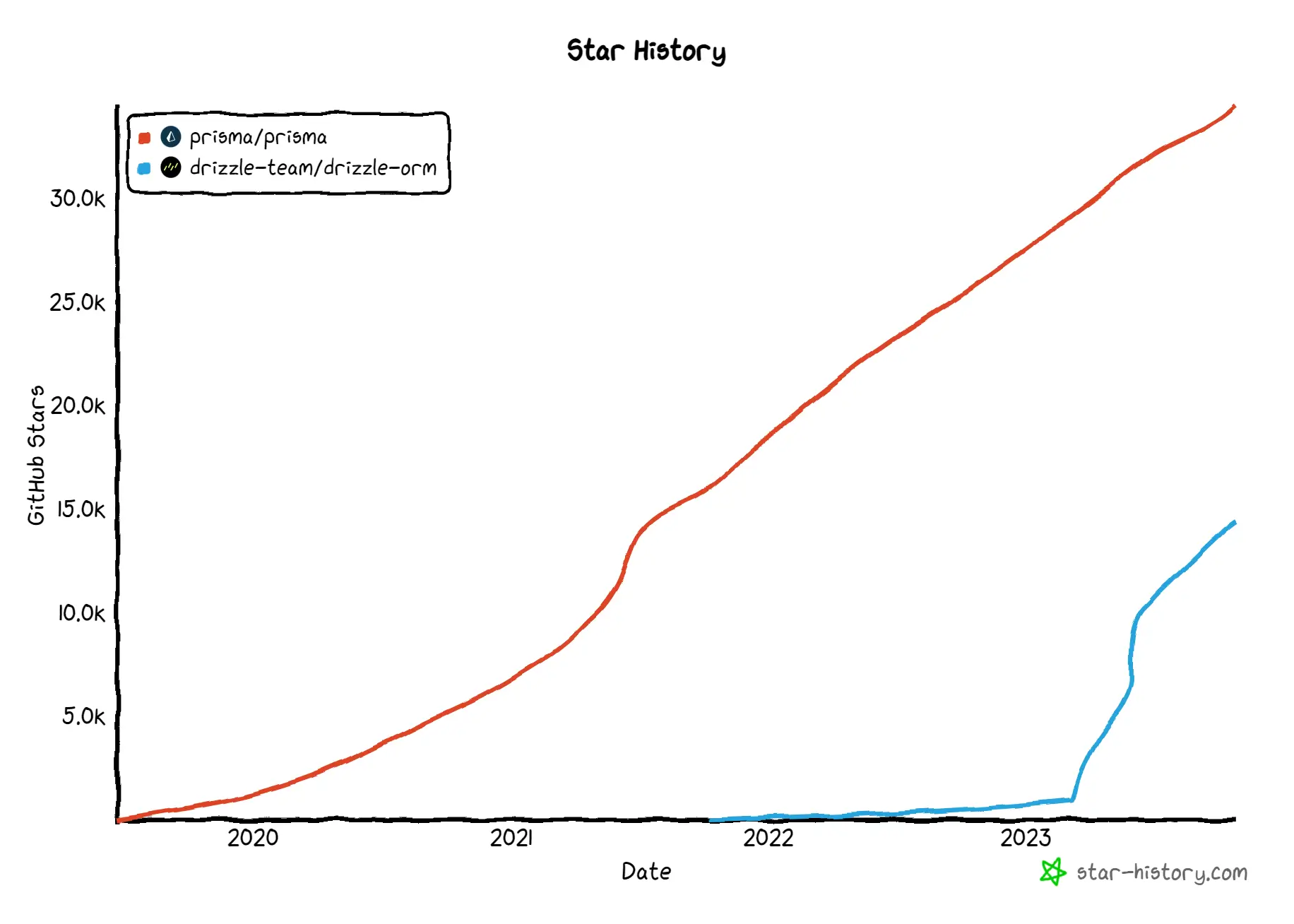
Drizzle's community is very dynamic and, according to current trends, is likely to become one of the most popular ORMs in the TypeScript ecosystem. Although it has fewer GitHub stars compared to Prisma, it's important to note that Drizzle is a more recent project.
Drizzle supports the main databases used in the market, such as PostgreSQL, MySQL, and SQLite.
🌟 Key Differentiator: What sets Drizzle apart from other solutions is its ability to provide specific libraries, which they refer to as "dialects," for each of these databases. This allows Drizzle to offer features tailored to the particularities of each database management system, rather than using generic libraries.
Drizzle uses TypeScript to define the data structure (schema).
export const customer = pgTable("customer", {
  id: uuid("id").defaultRandom().primaryKey(),
});

export const customerRelations = relations(customer, ({ many }) => ({
  order: many(order),
}));

export const order = pgTable("order", {
  id: uuid("id").defaultRandom().primaryKey(),
  customer_id: uuid("customer_id")
    .notNull()
    .references(() => customer.id),
});
In this case, a foreign key is established in the "order" entity that references the customer making the order, creating a relationship between the "customer" and "order" entities.
Drizzle provides flexibility - we can use a single .ts file for data schemas or multiple files to organize structures.
💡 Our Assessment: Drizzle might sacrifice some readability by using TypeScript for data relationships. While TypeScript users may not find this problematic, Prisma's approach to this task is more readable in our view.
Once a modification is made to the data schema, simply executing a command applies changes to the database. This process is very similar to Prisma's workflow.
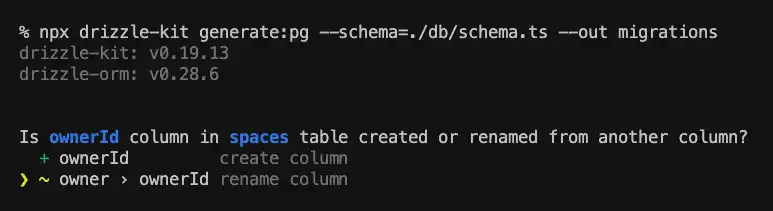
🔧 Key Feature: Drizzle includes smart column renaming protection - preventing accidental column deletion when renaming columns.
Since Drizzle uses TypeScript for data schema definition, it leverages type inference directly. No additional migration is needed to benefit from this inference once schema changes are made.
Drizzle provides SQL-like operators for queries, maintaining SQL-like syntax with a more styled appearance.
Key Advantage: Full TypeScript inference support in queries.
Consideration: Drizzle's SQL-based approach can be both an advantage and disadvantage, depending on the user's SQL familiarity.
vs Prisma: Prisma uses more beginner-friendly operators for those unfamiliar with SQL.
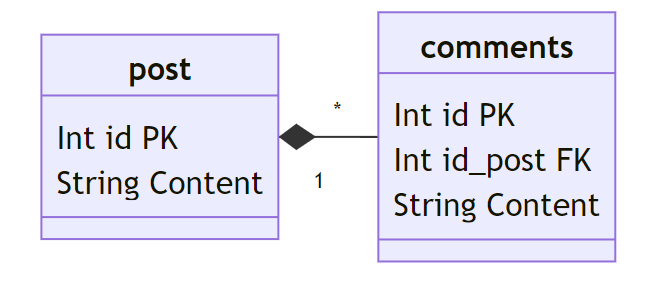
Example Data Structure:
export const posts = pgTable("posts", {
  id: serial("id").primaryKey(),
  content: text("content").notNull(),
});

export const postsRelations = relations(posts, ({ many }) => ({
  comments: many(comments),
}));

export const comments = pgTable("comments", {
  id: serial("id").primaryKey(),
  content: text("content").notNull(),
  postId: integer("post_id").references(() => posts.id),
});
Example Query:
await db.query.posts.findMany({
  where: (posts, { eq }) => eq(posts.id, 1),
  with: {
    comments: {
      where: (comments, { lt }) => lt(comments.createdAt, new Date()),
    },
  },
});
In this example:
eqoperator handles equality (finding post with id = 1)ltoperator means "less than" (comments before current date)
Drizzle stands out for its speed as it consists of a thin abstraction layer in TypeScript over SQL.
🎯 Key Difference: Drizzle performs only one query per statement vs. multiple queries in other ORMs.
Prisma's Approach:
- Uses Rust engine originally designed for multiple languages
- Currently focuses only on TypeScript/JavaScript
- Performs multiple queries for join operations
- Brings data to Rust engine for joins instead of using database joins
Drizzle's Advantage:
- Translates syntax to single SQL statement
- Leverages database-native join capabilities
- Significantly more efficient for complex operations
Extremely useful feature that optimizes query performance:
const p1 = db
  .select()
  .from(customers)
  .where(eq(customers.id, sql.placeholder("id")))
  .prepare("p1");

await p1.execute({ id: 10 });
await p1.execute({ id: 12 });
Benefits:
- ✅ Build query once, reuse multiple times
- ✅ Avoids repeated SQL translation
- ✅ Significant performance improvement
🔍 Important Note: These benchmarks are prepared by Drizzle's team. While from internal sources, they provide valuable comparative insights.
Benchmark Results - Select All: 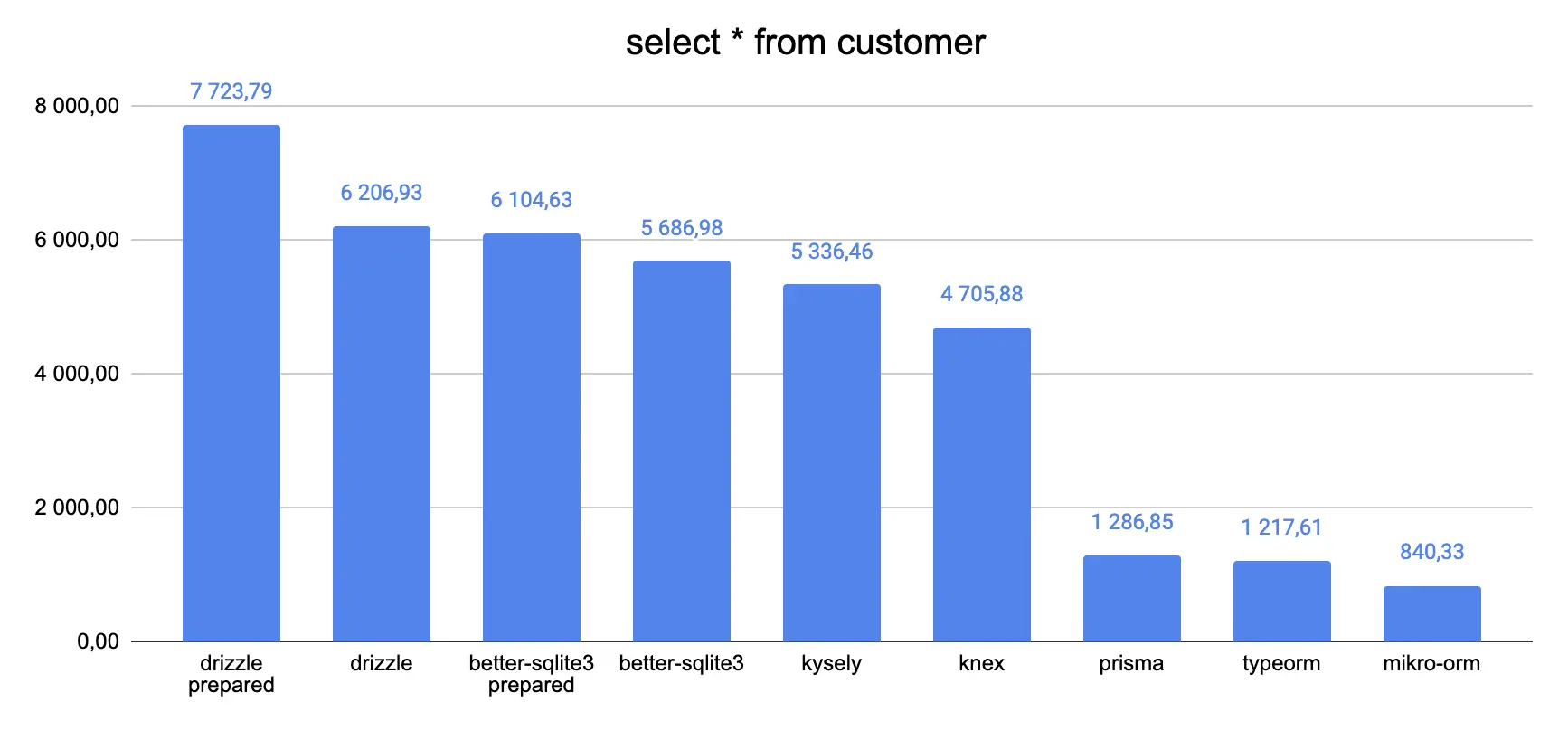
Even in simple "select all" queries, there's a marked difference between using prepared statements and not using them.
Benchmark Results - Complex Join: 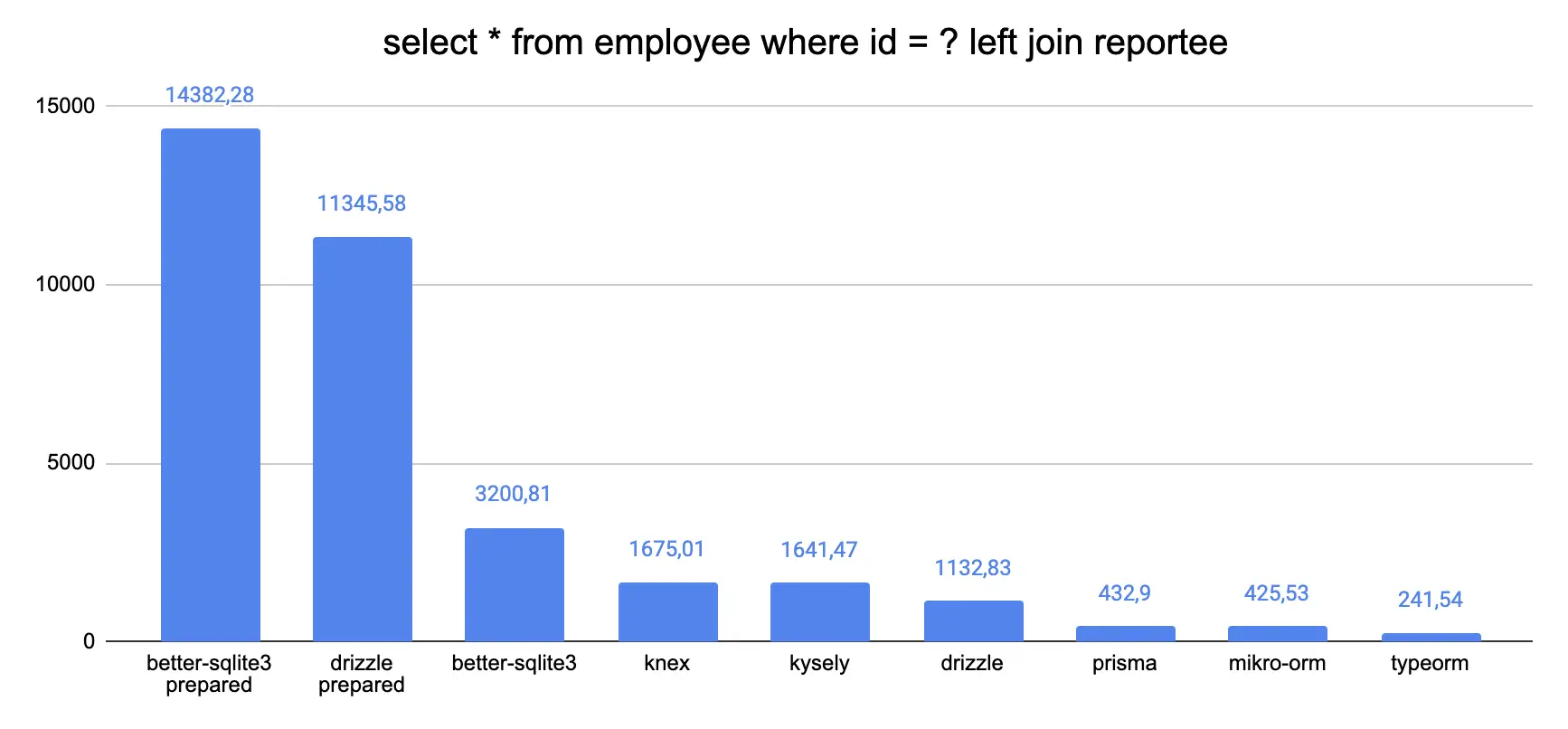
For complex queries (select + where + left join), the performance difference is even more dramatic.
- ✅ Excellent flexibility and simplicity
- ✅ Superior performance compared to most popular ORMs
- ✅ Excellent prepared statements implementation
- ✅ Single query per statement architecture
- ✅ Straightforward migration management
- ✅ Simple data schema definition
- ⚠️ Manual left join management required
- ⚠️ Not completely SQL-free - some SQL knowledge beneficial
Drizzle is an ideal choice for developers who:
- Value performance and speed
- Want simple migration and schema management
- Are comfortable with some SQL concepts
- Need TypeScript-first solution
🏆 Bottom Line: When using prepared statements and considering its efficient single-query approach, Drizzle stands as one of the most solid ORM choices in the TypeScript ecosystem.